The field of non-surgical spinal care is undergoing a significant transformation. For decades, linear traction has been a staple treatment for chronic back pain, but its one-dimensional approach has inherent limitations. Today, a new generation of technology is emerging, one that offers a more sophisticated, multidimensional, and evidence-based solution. This evolution is led by SMART (Spinal Mobilisation and Rotational Therapy), a groundbreaking approach that redefines the possibilities of non-surgical spinal decompression. Pioneered by companies like Vert Biotech, SMART technology is setting a new global benchmark in spinal care, offering superior clinical outcomes for a range of complex spinal conditions that were previously difficult to manage [1].
Understanding SMART Technology: Beyond Linear Decompression
SMART, or Spinal Mobilisation and Rotational Therapy, represents a paradigm shift from traditional static or intermittent traction. It is a multi-rotational 3D system that utilises intelligent mobilisation and controlled rotation to restore movement, reduce intradiscal pressure, and re-educate spinal function in ways that linear traction cannot [1]. The system's true 3-axis control allows for fully individualised decompression, targeting every spinal region from C1-T1 & T12-S-1. With a rotational range of up to 18 degrees and five automated modes, including decompression and twisting motions, lateral, twisting and decompression movements, and decompression in a rotated position, SMART technology can address a wide spectrum of spinal issues with unparalleled precision [2]. This approach integrates the proven principles of manual therapy techniques like Cox flexion-distraction and Cyriax rotation-distraction, but with the consistency and accuracy that only advanced technology can provide [2, 4].
The systems also adapt to the patient and their spinal threshold. Ensuring that the patient is never overstretched, whilst also ensuring that the patient is decompressed in the most effective manner. This means that the machine will adapt in real time with tiny microadjustments at the end range, fighting for as much movement and space as possible with the prescribed force in a safe and effective manner.
Clinical Advantages Over Traditional Linear Decompression
The limitations of traditional linear decompression are well-documented. Systematic reviews have shown that intermittent motorised traction often yields no significant difference in outcomes compared to control groups, highlighting the need for more advanced approaches [3]. Traditional traction applies force in a single plane, which is often insufficient for addressing the complex, multi-faceted nature of spinal pathologies. This is where SMART technology offers clear clinical advantages:
Twisting is one of the healthiest movements for stiff spines because it opens the facet joints without pushing pressure into the discs. It mobilises the spine in a way that flexion or extension can’t: safely, gently, and without load. That’s why SMART rotational mobilisation works so well for disc injuries, degenerative changes, and long-term stiffness.
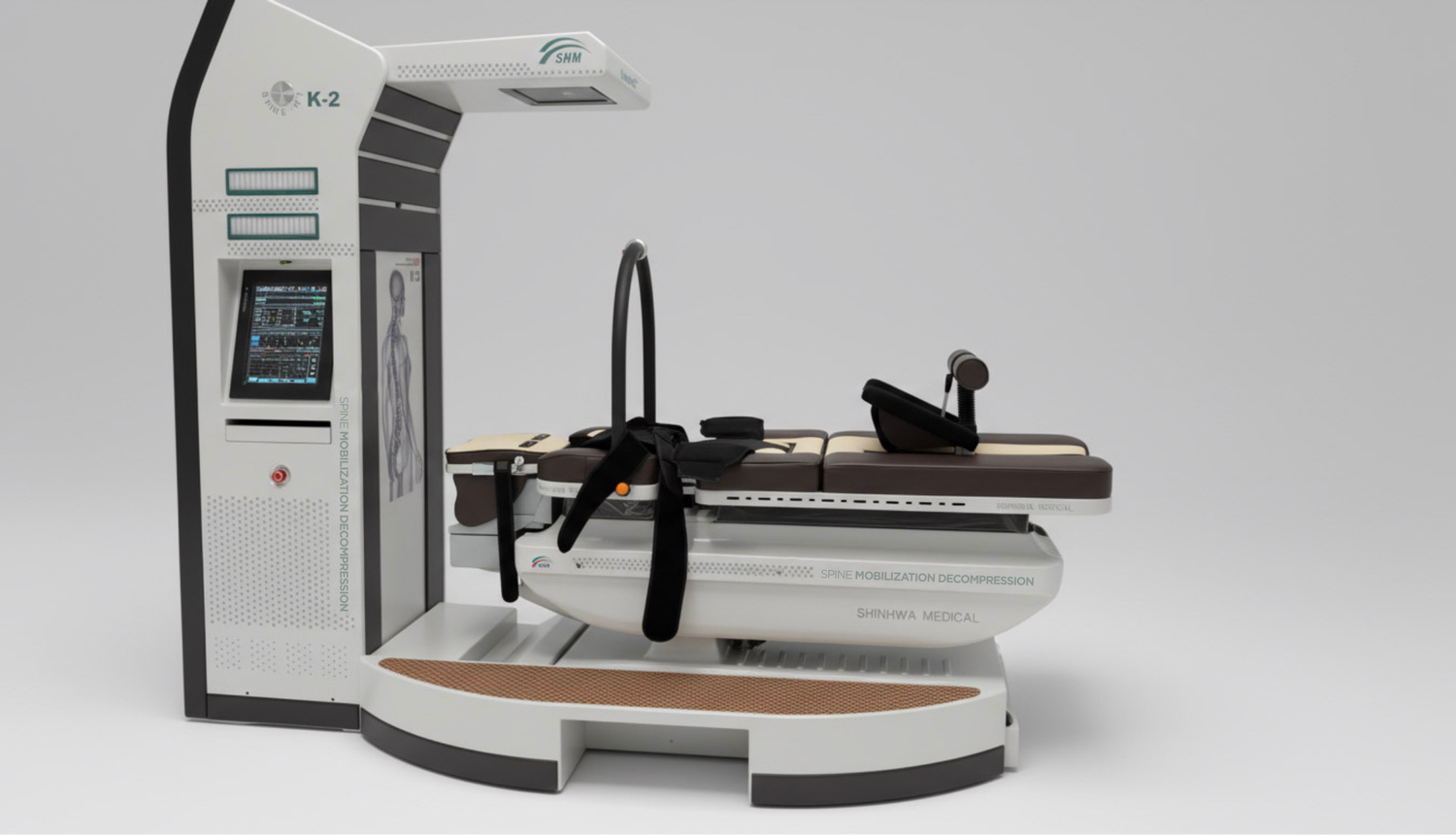
- For Chronic Stiffness: While linear traction may provide temporary relief, it does little to address the underlying joint restrictions that cause chronic stiffness. SMART technology’s multi-planar mobilisation actively restores normal joint motion patterns, leading to more lasting improvements in mobility and function.
- For Facet Joint Issues: Facet joint syndrome and other unilateral spinal conditions such as corkscrew hip are notoriously difficult to treat with linear decompression. SMART technology’s independent lateral flexion, and decompressed in rotation allow practitioners to target one-sided joint restrictions with precision, restoring symmetry and relieving tension in a way that a simple linear pull cannot [2].
- For Specific Disc Bulges: The concept of "directional preference" is critical in treating disc herniations, as different disc bulge directions require specific lines of force for effective reduction [5]. With up to 70% of patients exhibiting a directional preference, the one-size-fits-all approach of linear traction is often inadequate. SMART technology’s rotational and lateral capabilities allow for the application of force in the precise direction needed to address each patient's unique disc pathology, including posterolateral and lateral herniations [5].
Mimicking Manual Therapy with Precise, Automated Control
Manual therapy techniques have long been the gold standard for treating spinal pain. For instance, Cox flexion-distraction has been shown to drop intradiscal pressure to as low as -192 mmHg and widen the spinal canal foraminal area by 28%, while Cyriax rotation techniques are effective for disc reduction [4]. However, the effectiveness of manual therapy is highly dependent on the practitioner's skill, strength, and endurance. It is also difficult to standardise and replicate with consistency.
SMART technology bridges this gap by automating the principles of manual therapy with a level of precision and control that is humanly impossible. The system delivers consistent, measurable forces with real-time monitoring and micro-adjustments, ensuring millimetre-level accuracy throughout the treatment session [2]. This not only eliminates the issue of practitioner fatigue but also allows for the creation of repeatable, evidence-based protocols that can be customised to each patient's specific needs. By replicating the complex movements of manual therapy with robotic precision, SMART technology frees the practitioner from the physical demands of treatment, allowing them to focus on clinical decision-making and patient management.
A New Standard in Spinal Care
With a growing body of evidence supporting the use of mobilisation and manipulation for chronic low back pain, the clinical rationale for a multi-planar approach is clear [6]. SMART technology is already trusted by leading neurosurgical departments and premier medical facilities in over 25 countries, with over 3,000 systems in use worldwide [1]. It has proven effective for a wide range of conditions, including cervical and lumbar disc herniations, facet joint syndrome, degenerative disc disease, and spinal stenosis [2].
By combining the art of manual therapy with the precision of modern engineering, SMART technology represents the future of non-surgical spinal decompression. It addresses the fundamental limitations of traditional linear traction and offers a more effective, evidence-based solution for the complex spinal conditions that practitioners see every day. For clinics looking to elevate their standard of care and achieve superior outcomes for their patients, the integration of SMART technology is a logical and compelling next step.
References
[1] Vert Biotech. (n.d.). Vert Biotech.
[2] Vert Biotech. (n.d.). Spine MT Core.
[4] Cox Technic. (n.d.). How It Helps: Cox Technic for Spinal Pain Relief.