A New Paradigm in Cervical Spine Care
Neck pain is a ubiquitous clinical challenge, affecting a significant portion of the Australian population and representing a substantial burden on both individuals and the healthcare system. For practitioners specialising in upper-spine conditions, the goal is not merely to alleviate pain, but to restore function and long-term well-being. Central to this is the practice of cervical mobilisation, a cornerstone of manual therapy. However, this effective modality is not without its inherent risks. The complex anatomy of the cervical spine, particularly the delicate interplay of neurovascular structures during rotational movements, presents a veritable minefield for even the most skilled practitioner. The potential for iatrogenic injury, though rare, is a serious consideration that demands a meticulous approach to safety.
This article provides a technical deep-dive into a new paradigm in cervical spine care: Vert Biotech's Cervical SMART Decompression. This innovative, technology-driven approach is engineered to deliver the therapeutic benefits of cervical mobilisation and decompression while prioritising patient safety through advanced sensor technology and controlled, gentle limits. We will explore the specific anatomical risks associated with cervical rotation, deconstruct the limitations of traditional manual techniques, and detail how the Spine MT technology offers a safer, more precise, and ultimately more effective solution for practitioners and their patients.
The Anatomical Minefield: Deconstructing the Risks of Cervical Decompression
The cervical spine is a marvel of biomechanical engineering, affording the head a remarkable range of motion. However, this mobility comes at the cost of inherent instability, particularly in the upper cervical region. The C1-C2, or atlantoaxial, joint is responsible for approximately 50% of all cervical rotation [1]. This unique articulation, along with the course of the vertebral artery through the transverse foramina of the cervical vertebrae, creates a scenario where rotational movements, if not precisely controlled, can lead to significant neurovascular compromise.
Vertebral Artery Safety: A Primary Concern
A critical concern during any cervical mobilisation procedure is the safety of the vertebral arteries. These vital blood vessels ascend through the cervical spine, making a series of tortuous turns before entering the skull to supply the posterior aspect of the brain. It is during cervical rotation that the contralateral vertebral artery is most vulnerable, as it is stretched and potentially compressed. This can lead to a condition known as rotational vertebral artery syndrome, where head and neck rotation results in transient or, in severe cases, prolonged vertebrobasilar insufficiency [2].
The most feared complication of cervical manipulation is a vertebral artery dissection (VAD), a tear in the wall of the artery that can lead to stroke or other devastating neurological sequelae [3]. While the absolute risk of VAD is low, the potential for severe harm necessitates a cautious and informed approach. Research has shown that hyper-rotation at the C1-C2 joint, even with minimal facet contact, can create abnormal compressive sites for the vertebral artery [4]. Risk factors such as prior trauma, congenital anomalies like vertebral artery hypoplasia, and existing symptoms of vertebrobasilar insufficiency further heighten the risk [3].
The Complexity of Coupled Movements
Cervical spine kinematics are far from simple, uniplanar movements. Instead, they are characterised by complex, coupled motions. Pure rotation does not occur in isolation; it is invariably accompanied by a degree of lateral flexion and either flexion or extension, depending on the cervical level [5]. The biconvex nature of the C1-C2 articulation, for instance, results in a coupling phenomenon where the atlas (C1) extends during cervical flexion and vice versa [6]. In the lower cervical spine, the saddle-shaped articulations permit rotation and flexion but are resistant to pure lateral flexion, which can only be achieved through coupled rotational movement [6].
This intricate interplay of movements means that a practitioner cannot simply apply a rotational force without inducing other, potentially undesirable, motions. This complexity underscores the difficulty of manually controlling all variables during a mobilisation procedure and highlights the potential for unintended stress on cervical structures.
Proprioceptive Disruption: The Silent Saboteur
The cervical spine is richly innervated with mechanoreceptors, including muscle spindles and Golgi tendon organs, which provide a constant stream of proprioceptive information to the central nervous system. This feedback is crucial for sensorimotor control, balance, and the maintenance of head and neck posture [7]. In patients with chronic neck pain, this delicate proprioceptive system is often impaired. Uncontrolled or excessive mobilisation can further disrupt this system, leading to erroneous sensory signals, impaired muscle coordination, and a potential exacerbation of symptoms [7]. Restoring normal proprioceptive function is, therefore, a key therapeutic goal, and any intervention must be gentle and precise enough to facilitate this, rather than hinder it.
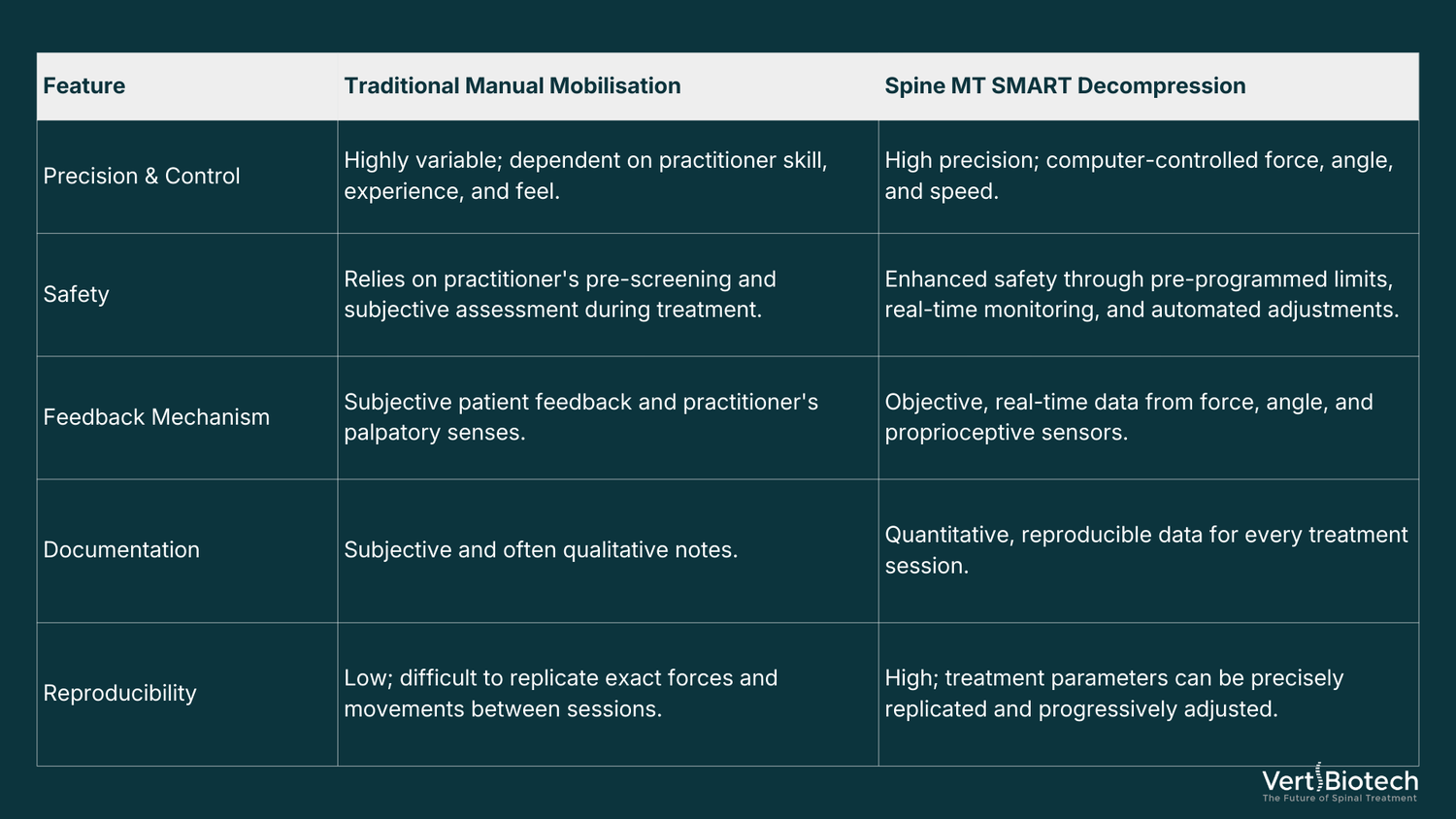
Traditional vs. Technology-Enhanced Mobilisation: A Comparative Analysis
For decades, manual mobilisation has been the standard of care for many neck pain conditions. While often effective, it is not without its limitations. The evolution of technology has now paved the way for a more refined and safer approach to cervical decompression.
The Vert Biotech Difference: Engineering Safety into Cervical Mobilisation
Cervical SMART Decompression system was designed from the ground up to address the inherent risks of cervical mobilisation. By integrating advanced sensor technology with sophisticated control algorithms, it offers a level of safety and precision that is simply unattainable with manual techniques.
Proprietary Sensor Technology: The Heart of the System
The cornerstone of the SMART Decompression Technology is its suite of proprietary sensors. These include:
- Real-time Force and Angle Sensors: These sensors continuously monitor the exact forces and angles being applied to the cervical spine, ensuring that treatment parameters remain within a safe and therapeutic range.
- Proprioceptive Feedback Sensors: This is where the "SMART" in SMART Decompression truly comes to life. The system is able to detect subtle changes in muscle guarding and resistance, which are indicative of the patient's mechanoreceptor and proprioceptive responses. If the system detects an increase in muscle guarding, it can automatically reduce the force or alter the movement pattern to avoid a protective muscle spasm and ensure the patient remains relaxed and comfortable.
- Closed-Loop Feedback System: All sensor data is fed into a closed-loop feedback system, which allows for continuous, automated adjustments to the treatment in real-time. This creates a dynamic and interactive therapeutic experience that is tailored to the individual patient's response.
Ensuring Maximum Safety: A Multi-Faceted Approach
The integration of this sensor technology translates directly to enhanced patient safety. The system's gentle, controlled, and precise limits on rotation and other movements are specifically designed to protect the vertebral artery and other neurovascular structures. The progressive loading protocols allow for gradual tissue adaptation and mechanoreceptor accommodation, preventing the sudden, uncontrolled movements that can lead to injury. Furthermore, the system's ability to monitor and control for coupled movements ensures that the therapeutic intervention is targeted and specific, minimising unintended stress on adjacent structures.
Clinical Implications and Benefits for the Modern Practitioner
The adoption of the Spine MT’s Cervical SMART Decompression technology has significant implications for the modern practitioner. The objective data provided by the system can inform clinical decision-making, allowing for a more evidence-based approach to treatment planning and progression. This is particularly valuable when managing patients with complex upper-spine conditions, where the margin for error is small.
For the practitioner, the benefits are numerous. The system enhances safety, reduces the physical strain associated with manual therapy, improves patient confidence, and provides robust documentation for clinical records and potential research. It represents a shift towards a more data-driven and technologically-assisted model of care, one that aligns with the broader trends in modern medicine.
A Safer, Smarter & More Effective Future for Cervical Decompression
The anatomical complexities of the cervical spine demand a sophisticated and safety-conscious approach to mobilisation. While traditional manual techniques have their place, they are inherently limited by their variability and lack of precise control. Cervical SMART Decompression represents a significant leap forward, offering a safer, smarter, and more effective solution. By engineering safety into the very fabric of the system, it empowers practitioners to deliver the therapeutic benefits of cervical decompression with an unprecedented level of confidence and precision. For the discerning practitioner focused on providing the highest standard of care, this technology is not just an adjunct to practice; it is the future of cervical spine care.
References
[1] Swartz, E. E., Floyd, R. T., & Cendoma, M. (2005). Cervical Spine Functional Anatomy and the Biomechanics of Injury Due to Compressive Loading. Journal of Athletic Training, 40(3), 155–161.
[2] Kaale, B. R., McArthur, T., & Kaale, K. (2024). A Case Report: Entrapment of the Vertebral Artery between the Skull and the First Cervical Vertebra during Head and Neck Rotation. Medical Research Archives, 12(11).
[3] Mann, T., & Refshauge, K. M. (2001). Causes of complications from cervical spine manipulation. Australian Journal of Physiotherapy, 47(4), 255-266.
[4] European Society of Medicine. (2024). Vertebral Artery Entrapment during Cervical Rotation.
[5] Zhao, X., et al. (2013). Three-dimensional analysis of cervical spine segmental motion in asymptomatic subjects. Spine, 38(11), E643-E649.
[6] Penning, L. (1978). Normal kinematic of the upper cervical spine. Spine, 3(4), 367-377.
[7] Peng, B., et al. (2021). Cervical Proprioception Impairment in Neck Pain-Pathophysiology, Clinical Evaluation, and Management: A Narrative Review. Pain and Therapy, 10(1), 143-160601-1449.